Featured Arsenic Adsorption Materials
Company Overview & Technical Strengths
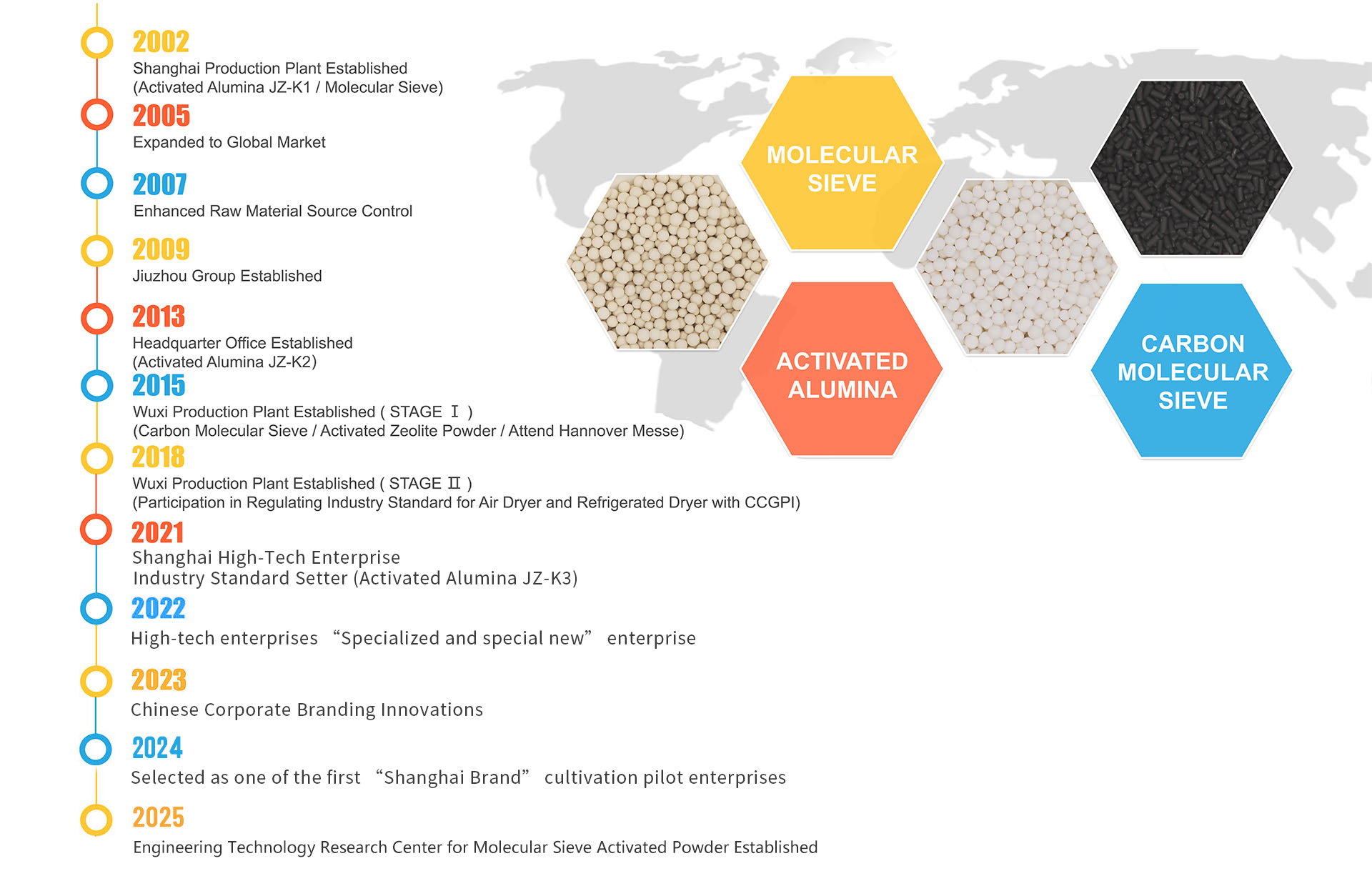
Shanghai Jiuzhou Chemicals Co., Ltd. Located in the biggest Economic Development city Shanghai. Over the years Jiuzhou has always adhered to the “quality control, innovation “principles, committed to the development, research, manufacturing of high quality innovative chemical products. Our main products includes various molecular sieve powders, molecular sieves, activated powder, activated alumina, aluminum oxide catalysts, different types of alumina packing and ceramic balls, sodium silicates, aluminum hydroxide,zeolite 4A, sodium carbonates, SLES, etc. Our all products passed the ISO9001: 2008 quality management system certification and TUV & SGS Certification.
Jiuzhou factory has a professional and world-class research team and experts in chemical product resources.We use the best in international prodution technonlogy and professional production equipment, constructed in line with national standards and by the large multipurpose plant monitoring, analysis instrument composition the central laboratory. And in quality inspection aspect Jiuzhou have controlled and that products meet international standards.
Jiuzhou's technical strength and industry reputation are leading the industry in the field of desiccants, with senior experts and technical reserves, automated multi-functional production workshops, and a central laboratory and dynamic laboratory composed of large-scale monitoring and analysis instruments. It is in quality control And in terms of supporting services, a set of scientific and complete operating system has been established Joozeo products are exported to all parts of the world, and have established a distribution network in the United States, Southeast Asia, Japan, Europe, North and South America, the Middle East and other places to provide partners with high-quality products, customized services, and more energy-saving and environmentally friendly adsorption solutions.
The Critical Challenge of Arsenic Contamination in Global Water Supplies
Arsenic contamination in drinking water is one of the most severe public health crises of the 21st century. Occurring naturally in geological formations or introduced through anthropogenic activities such as mining, pesticide application, and industrial manufacturing, arsenic exists primarily in two oxidation states in aqueous environments: arsenite [As(III)] and arsenate [As(V)]. Both forms are highly toxic, carcinogenetic, and mutative. Long-term exposure to concentration levels above the World Health Organization (WHO) maximum contaminant level of 10 micrograms per liter (μg/L) leads to arsenicosis, skin lesions, cardiovascular diseases, and multiple forms of cancer.
Mitigating this contaminant requires robust, selective, and cost-effective purification materials. Traditional methods such as coagulation, reverse osmosis, and standard ion-exchange resins often suffer from high operational costs, complex maintenance, or low selectivity in the presence of competing anions like phosphates, silicates, and sulfates. This has driven the global environmental engineering sector toward engineered molecular sieve zeolites as a highly efficient, sustainable, and scalable solution for selective arsenic remediation.
"Engineered molecular sieve zeolites represent a paradigm shift in water treatment, offering tailored pore sizes and customizable surface chemistry to target toxic anions selectively."
Understanding Molecular Sieve Zeolites in Environmental Applications
Molecular sieve zeolites are crystalline, hydrated aluminosilicates characterized by highly ordered, three-dimensional framework structures composed of SiO4 and AlO4 tetrahedra sharing oxygen atoms. This configuration generates a network of uniform channels and cavities of molecular dimensions (typically ranging from 3 to 10 Å). The substitution of trivalent aluminum (Al3+) for tetravalent silicon (Si4+) within the framework imparts a net negative charge, which is naturally balanced by exchangeable cations (such as Na+, K+, Ca2+, and Mg2+) located within the channels.
While natural zeolites exhibit exceptional cation exchange capacities (CEC)—making them highly suitable for removing heavy metal cations like lead, copper, and cadmium—their native negative surface charge limits their ability to directly adsorb anionic arsenic species (such as H2AsO4- and HAsO42-). To overcome this thermodynamic barrier, material scientists utilize surface modification techniques, transforming these aluminosilicates into highly effective anion adsorbents.
Surface Modifications and Activation Mechanisms for Arsenic Adsorption
To convert molecular sieve zeolites into active arsenic-scavenging materials, the internal and external surfaces of the zeolite framework must undergo functionalization. The primary modification strategies include:
1. Cationic Surfactant Modification (SMZ)
By treating the zeolite with high-molecular-weight cationic surfactants, such as hexadecyltrimethylammonium (HDTMA), a surfactant bilayer (or admicelle) is formed on the zeolite surface. This layer reverses the surface charge from negative to positive, allowing the modified zeolite to capture anionic arsenic species through electrostatic attraction.
2. Metal Oxide Loading and Wet Impregnation
Loading the zeolite framework with transition metal oxides or hydroxides—specifically iron (Fe), manganese (Mn), lanthanum (La), or zirconium (Zr)—creates highly active adsorption sites. Iron-modified zeolites, for example, leverage the high affinity of iron oxides for arsenic. The arsenic ions bind to the iron oxide nanoparticles via inner-sphere complexation, displacing hydroxyl groups to form stable monodentate or bidentate complexes.
- High Selectivity: Metal-modified zeolites maintain high arsenic removal rates even in the presence of high concentrations of competing ions like sulfate and chloride.
- Robust Physical Structure: The rigid zeolite framework protects the active metal oxide nanoparticles from washing out during high-pressure water flow.
- Dual-Action Capacity: Some modified zeolites can simultaneously oxidize As(III) to the more easily removable As(V) state while capturing both forms within the crystalline matrix.
Industrial & Commercial Landscape of Zeolite-Based Water Treatment
The global market for arsenic removal technologies is expanding rapidly, driven by tightening environmental regulations, growing industrial wastewater management requirements, and ESG (Environmental, Social, and Governance) mandates. Molecular sieve zeolites have transitioned from laboratory-scale research to mainstream industrial adoption due to their economic viability and operational simplicity.
Commercially, zeolite-based media are utilized in municipal water treatment plants, industrial effluent remediation facilities, and point-of-use (POU) domestic filtration systems. The cost-to-performance ratio of modified zeolites is significantly superior to synthetic organic resins and membrane filtration. Because natural zeolites are abundant and synthetic zeolites can be produced with high consistency, they represent a highly scalable material choice for water treatment utilities globally.
Deep-Dive Application Scenarios
1. Municipal Drinking Water Treatment Plants
In municipal installations, modified zeolite media are packed into large-scale gravity or pressure filters. Water passes through the media beds where arsenic ions are rapidly adsorbed. The process requires minimal energy compared to reverse osmosis, drastically reducing the carbon footprint of municipal water utilities. The regeneration of spent media can be achieved using mild alkaline solutions, restoring adsorption capacity for multiple cycles.
2. Industrial Wastewater and Mining Effluents
Mining activities and metallurgical processing generate highly acidic wastewater with elevated arsenic concentrations. Engineered molecular sieve zeolites, designed to withstand extreme pH conditions, are deployed to treat these industrial streams before discharge. Their high thermal stability and resistance to chemical degradation make them ideal for challenging industrial environments.
3. Decentralized and Rural Water Purification Systems
In developing regions where centralized water infrastructure is lacking, simple gravity-fed filter columns packed with iron-modified zeolite granules provide a life-saving solution. These systems require no electricity, complex chemical dosing, or highly trained operators, making them highly suitable for remote communities affected by geogenic arsenic contamination.
Comparative Analysis: Zeolites vs. Traditional Adsorbents
When evaluated against traditional arsenic removal media, modified molecular sieve zeolites offer distinct advantages:
Zeolites vs. Activated Alumina
Activated alumina is highly sensitive to pH variations, experiencing a significant decline in arsenic removal efficiency at pH levels above 8.0. Modified zeolites, particularly those functionalized with iron and manganese oxides, maintain stable arsenic adsorption capacities across a broader pH spectrum (6.0 to 9.0), which is typical for natural groundwater resources.
Zeolites vs. Synthetic Ion-Exchange Resins
Synthetic resins are susceptible to organic fouling and mechanical degradation under continuous flow. Zeolites possess a rigid, inorganic crystalline structure that does not swell or shrink, ensuring stable hydraulic conductivity and preventing compaction within filter beds. Furthermore, zeolites are highly resistant to biological growth, reducing the risk of biofouling.
Future Trends and Technological Innovations
The next generation of molecular sieve zeolites for arsenic removal is focused on nanotechnology and sustainable synthesis. Researchers are developing nano-zeolite composites that offer significantly higher surface areas and faster adsorption kinetics. Furthermore, the synthesis of zeolites from industrial byproducts, such as coal fly ash, is gaining momentum, aligning water treatment practices with circular economy principles.
Additionally, the integration of real-time sensor technologies and machine learning algorithms allows water utilities to monitor zeolite bed saturation levels dynamically. By analyzing influent water chemistry, system operators can predict exactly when the media will require regeneration, optimizing chemical usage and minimizing operating costs.