

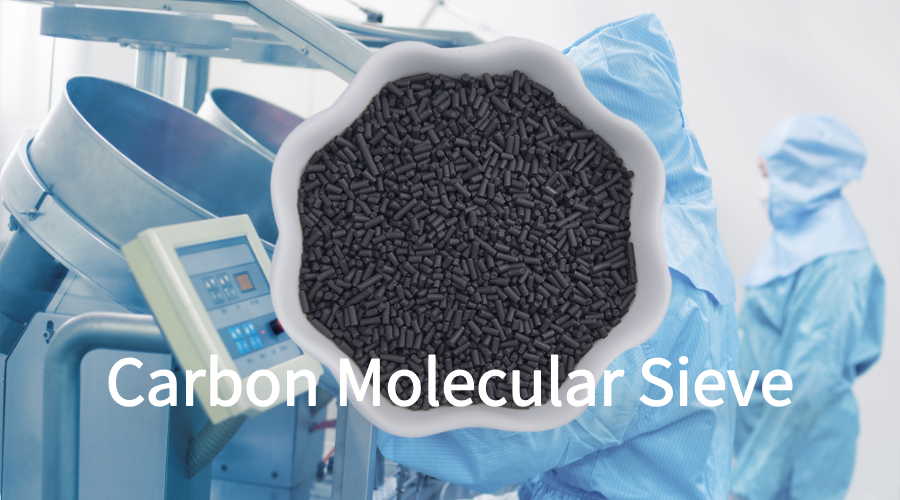
Carbon molecular sieve (CMS) is widely used in PSA nitrogen generation because it can separate air by utilizing the difference in diffusion rates between gas molecules inside its micropores.
Although nitrogen and oxygen molecules are similar in size, oxygen diffuses much faster within the pore structure of CMS, while nitrogen moves more slowly. When air passes through an adsorption tower filled with CMS, oxygen is preferentially and rapidly adsorbed, allowing nitrogen to pass through and produce high-purity nitrogen gas.
This separation process relies entirely on physical adsorption rather than chemical reactions, enabling efficient operation at ambient temperature. CMS can also be regenerated simply by reducing pressure, allowing the PSA system to operate continuously and economically. The more precise the pore size distribution and the stronger the adsorption kinetics, the higher the nitrogen purity and production efficiency that can be achieved.
Shanghai Joozeo’s carbon molecular sieve is engineered with faster oxygen adsorption rates, uniform pore structures, and excellent mechanical strength, ensuring long-term stability in PSA nitrogen generators. From food packaging and chemical processing to electronics manufacturing and metal treatment, Joozeo CMS supports nitrogen production from 95% up to 99.999% purity with consistent and reliable performance.
The ability of carbon molecular sieve to produce nitrogen reflects advanced material design at the microscopic level and forms the foundation of efficient PSA technology—while high-quality CMS remains essential for ensuring system performance and reliability.
Post time: Dec-11-2025